Gustaw Szymański
Denis Villeneuve is one of the most prominent names in contemporary cinema. Since 2009, he has been putting out phenomenal films, one after another, and became recognized as a master of creating tension and realistically depicting violence. However, the most important moment in his career is a significantly more recent one – when he decided to take up one of Hollywood’s greatest challenges and create a sequel to one of the most highly praised movies of all time, Blade Runner. Despite doubts, Blade Runner 2049 released in 2015, lived up to expectations, and quickly became a modern classic, finding itself at the top of many lists of greatest movies of the past decade.
This wasn’t enough for Villeneuve, and he decided to take up another challenge, one faced by many in the past without much success. He wanted to adapt the famous Frank Herbert sci-fi novel, Dune. As I highly enjoyed reading the source material, this was one of my most anticipated movies this year and with every trailer or other promotional material I saw, both my expectations and my excitement rose. Finally, on October 22 (in Poland) this production was released to theaters and after watching it I can confidently say that Villeneuve delivered again.

Dune is set in a unique, futuristic reality where humans have access to wonderful skills and high technology, including space travel. All of it is based on a special substance with many magical properties: spice. Spice quickly became the most valuable substance in this universe mostly because it could be found only on one planet called Arrakis. For centuries, this planet had been a property of the House Harkonnen, which gathered a fortune harvesting spice and exploiting its monopoly on it as much as possible. This however was going to change and by the decision of the emperor himself, another family, the House Atreides, will be in charge of these priceless lands. Although it may seem like a great opportunity for its members, Duke Leto Atreides, the head of the family, knows that this decision wasn’t just an act of the emperor’s generosity. His son, young Paul Atreides, also realizes that. Paul’s prophetic dreams show him the future where he will need to prove his bravery and strength in order to survive multiple dangers awaiting him on Arrakis. Even though it may seem that I’ve spoiled the plot of the whole movie, this is just a tiny fraction of what Herbert’s world has to offer. It is filled with various houses, sects, tribes and every one of them has an extensive history and a deep and unique culture with a ton of compelling rituals to discover.
This is the main reason this story has been so challenging to adapt. On the one hand, the movie should focus on the main plot instead of the presentation of the world, because, as we know, a good story can’t be constructed solely from the exposition. This attitude, however, would strip out this film from so many elements which made the original novel so great. Villeneuve in my opinion found a quite reasonable solution to this issue. He divided the story of the book in two which made it possible for the film to contain more of the things mentioned earlier, and to still focus on the main plot, just telling it in a slower and less fixated way. This worked out quite well. He managed to make a real movie and not an animated guidebook of Arrakis, while still fully presenting Dune’s world without omitting any of its aspects.
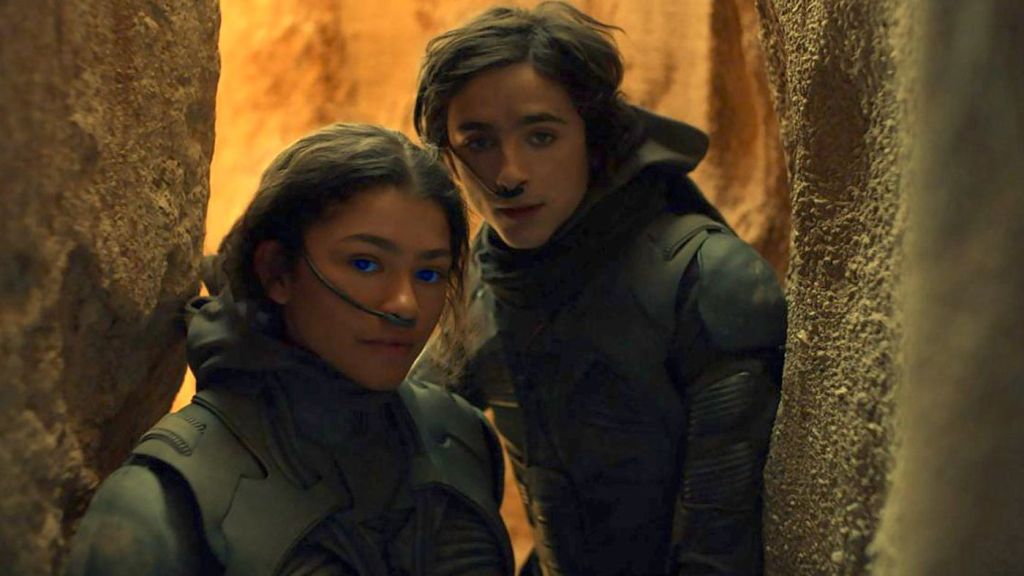
One of the most important certainly has to be the wide set of interesting and colorful characters and, in this case, those responsible for casting, as well as the actors themselves, have truly outdone themselves. Dune has possibly one of the strongest casts of all movies this year. Timothée Chalamet, Oscar Isaac, Zendaya, and many other top-notch Hollywood stars appear, and although it may seem as if they were meant to simply stir attention around the premiere, each of them perfectly fits their character and corresponds to descriptions provided by the novel. The one role, which for me stood out the most is that of Lady Jessica, played by Rebecca Ferguson. Before I saw the movie, I was worried because she didn’t appear much in the film’s trailers, and it would be quite reckless to omit such an important character. Fortunately, in the movie she has nearly as much screen time as Paul and uses every minute of it to showcase her exceptional acting skills. She fully captured the complexity of the character of Lady Jessica and presented her with the same attention to detail as Herbert. The outlier here for me was Jason Momoa. He didn’t play Duncan Idaho poorly, however, in comparison with others, his character felt far less interesting and complex.
Those familiar with Blade Runner 2049 probably knew that Villenueve’s visual interpretation of Dune would be unimpeachable. Villeneuve already in his earlier productions proved that he perfected the art of telling a story using images. The amount of information and emotion that this man can convey in one shot is, to say the least, impressive. In Dune, the shots hold the same importance as dialogues, therefore it is a good thing they are wonderful. Here every shot is majestic and, in order to let the viewer truly appreciate it, Villeneuve lets every one of them take their time and slowly reveal wonders hidden in this world. That is one of the reasons the movie is intimidatingly long (2 hours 35 minutes). However, because of its hypnotizing beauty, you never realize that. What heavily contributed to this, are phenomenal set pieces and special effects which this movie has elevated to a new, exciting level. The producers are above simply presenting objects created by Herbert’s imagination. They show them from various perspectives using many different lighting methods. The final effect is not only stunning but also unique.
Lastly, Hans Zimmer’s music hugely contributed to the atmosphere of this production. Zimmer, in order to make this world even more special, tried to create new sounds and use them in a way he thought people would in the distant future. This resulted in a truly special soundtrack. At first, it may even feel a little odd, however, after a while, when the viewer embraces its sound, it creates such a dense and magical atmosphere that greatly complements the movie’s beautiful pictures.
There aren’t any absolutely negative aspects of this movie, however, because of the specificity of the story, Dune is mostly groundwork for its own continuation. Therefore, although we are introduced to all these amazing characters, there aren’t many chances to see them in action. The exception here is Paul, who already experienced many things during this part of the story and by its end, we could notice the influence certain events had on him. This issue is especially visible in the ending of the movie which feels more like the beginning of something great, than a finale. Villeneuve teases us with amazing events through Paul’s visions. Many will be revealed to the viewer only in the continuation. As a result, when I walked out of the cinema instead of satisfaction, what I felt was just pure excitement for the second part, which unfortunately was quickly extinguished when I found out that it will be released no earlier than in 2023.
Dune is a truly great movie, which certainly can be described as a unique experience. After numerous tries, it was Denis Villeneuve who found the best way to adapt Herbert’s classic novel. He took an amazing set of talented actors and inserted them into Dune’s magical world, which he portrayed with immense focus. Stunning imagery and an exceptional soundtrack played a crucial role in the film’s promotion and made this universe feel like nothing ever shown in cinema before. This is a perfect movie in order to escape our grey and dull, autumn reality and although its ending is a little bit anticlimactic, Dune is definitely worth your time.
 Dawka Daily
Leave a comment